Introduction
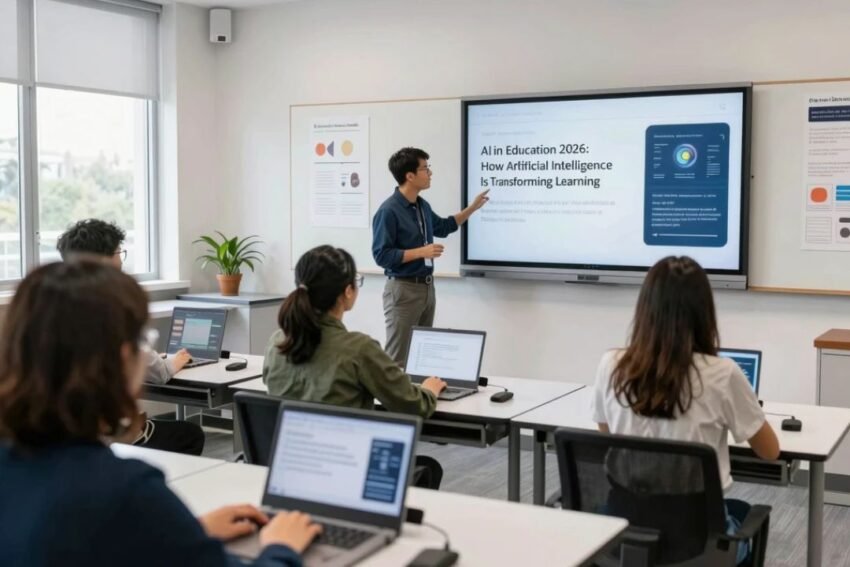
Artificial intelligence is changing education faster than many traditional technologies before it. In 2026, AI tools are being used to support students, teachers, schools, universities, and online learning platforms. From personalized tutoring and automated feedback to lesson planning and language learning, artificial intelligence is becoming an important part of the modern education ecosystem.
AI does not simply provide another way to access information. It can analyze learning patterns, generate educational content, explain difficult concepts, and help students practice skills interactively.
However, AI in education also creates important questions about academic integrity, privacy, accuracy, bias, and the role of teachers.
This guide explores AI in education in 2026, including its major applications, benefits, challenges, responsible-use strategies, and the future of AI-powered learning.
Note: AI capabilities and educational policies change quickly. Schools, universities, and instructors may have different rules regarding AI use, so students should always follow the policies that apply to their course or institution.
What Is AI in Education?
AI in education refers to the use of artificial intelligence technologies to support teaching, learning, assessment, administration, and educational research.
AI-powered systems can analyze information and generate or recommend content based on user inputs.
Common applications include:
- AI tutoring
- Personalized learning
- Automated feedback
- Lesson planning
- Language practice
- Study assistance
- Educational content generation
- Student-support systems
- Administrative automation
Why AI in Education Matters in 2026
Education has traditionally followed standardized approaches, but students learn at different speeds and have different strengths.
AI can potentially help personalize learning by adapting explanations, practice questions, and learning activities to individual needs.
At the same time, teachers can use AI to reduce repetitive administrative work and spend more time interacting with students.
AI-Powered Personalized Learning
One of the biggest potential benefits of AI is personalized education.
An AI learning system can analyze a student’s performance and identify areas where additional practice may be useful.
For example, if a student repeatedly struggles with fractions, an AI tutor could provide:
- Simpler explanations
- Additional examples
- Practice questions
- Step-by-step guidance
- Review exercises
This can create a more individualized learning experience.
AI Tutors
AI tutors can provide conversational support to students.
Students can ask questions in natural language and receive explanations.
An AI tutor may help with:
- Mathematics
- Science
- History
- Writing
- Programming
- Languages
- General study skills
However, AI-generated answers can contain errors. Students should verify important information with reliable educational materials and instructors.
AI for Homework Help
AI can be useful when students are stuck on a difficult concept.
Instead of asking AI to simply provide an answer, students can ask it to explain the underlying process.
For example:
Less useful approach:
“Give me the answer.”
Better learning approach:
“Explain how to solve this problem step by step and let me try the final calculation.”
The second approach encourages understanding rather than dependence.
AI and Mathematics Education
Mathematics is an area where AI can provide interactive support.
Students can use AI tools to:
- Explain formulas
- Generate practice problems
- Identify calculation mistakes
- Demonstrate solution methods
- Create quizzes
- Review concepts
Teachers can also use AI to create differentiated practice materials.
AI in Science Education
AI can support science learning through explanations, simulations, data analysis, and personalized practice.
Students may use AI to explore:
- Biology
- Chemistry
- Physics
- Environmental science
- Astronomy
For advanced topics, AI can help explain concepts at different levels of difficulty.
AI in Language Learning
Language education is another area where AI can be particularly useful.
AI-powered tools can help students practice:
- Vocabulary
- Grammar
- Pronunciation
- Conversation
- Reading
- Writing
Conversational AI can provide opportunities to practice languages without requiring a human conversation partner at every moment.
AI Writing Assistance
AI can help students brainstorm ideas, organize information, and improve clarity.
Potential uses include:
- Brainstorming
- Outlining
- Grammar feedback
- Sentence improvement
- Vocabulary suggestions
- Editing
However, students should understand their school’s rules about AI-assisted writing.
Submitting AI-generated work as original work may violate academic-integrity policies.
AI and Academic Integrity
One of the biggest challenges associated with AI in education is academic integrity.
Students may use AI to generate:
- Essays
- Homework answers
- Reports
- Coding assignments
- Discussion posts
If a course prohibits such use, submitting AI-generated material can create serious academic problems.
The best approach is to understand the specific AI policy for each class.
AI Detection Tools
Some institutions use AI-detection tools to identify potentially AI-generated content.
However, AI detection is not perfectly reliable.
Students should not assume that a detector can definitively determine authorship.
The safest approach is to follow academic-integrity policies and produce work honestly.
AI for Teachers
AI isn’t only a student tool.
Teachers can use AI for tasks such as:
- Lesson planning
- Brainstorming activities
- Creating practice questions
- Generating examples
- Drafting rubrics
- Differentiating materials
- Summarizing classroom feedback
Teachers should review AI-generated material before using it with students.
AI Lesson Planning
Creating lessons can require significant preparation.
AI can help teachers brainstorm:
- Lesson objectives
- Activities
- Discussion questions
- Examples
- Quizzes
- Practice exercises
Teachers remain responsible for ensuring that content is accurate, age-appropriate, inclusive, and aligned with curriculum requirements.
AI-Generated Educational Content
AI can generate educational materials quickly.
For example, a teacher could request:
- A beginner-level explanation
- An advanced explanation
- Ten practice questions
- A classroom discussion activity
- A vocabulary quiz
The teacher can then edit and adapt the material.
AI and Automated Feedback
AI can help provide feedback on certain types of student work.
It may identify:
- Grammar problems
- Common mistakes
- Missing concepts
- Formatting issues
- Repeated errors
Automated feedback can help students receive guidance faster, but human review remains important for complex work.
AI and Accessibility
AI may improve educational accessibility for some learners.
Potential applications include:
- Text-to-speech
- Speech-to-text
- Simplified explanations
- Translation
- Captioning
- Personalized interfaces
These technologies can make educational materials easier to access for students with different needs.
AI Translation in Education
Language barriers can make educational resources difficult to access.
AI translation tools can help students understand materials in other languages.
However, machine translation can sometimes misunderstand context, technical terms, or cultural nuances.
Important academic materials should be checked carefully.
AI for Student Productivity
AI can help students organize their workload.
Possible uses include:
- Study schedules
- Task lists
- Revision plans
- Flashcard generation
- Quiz creation
- Note organization
Students should use AI to support organization rather than replacing their own planning skills.
AI and Online Learning
AI is closely connected to the growth of online education.
Online platforms can use AI to:
- Recommend courses
- Personalize lessons
- Identify knowledge gaps
- Generate quizzes
- Provide automated feedback
- Adapt difficulty levels
This could make digital education more responsive to individual learners.
AI in Higher Education
Universities are exploring AI across teaching, research, administration, and student services.
Potential applications include:
- AI tutoring
- Research assistance
- Course recommendations
- Administrative chatbots
- Student support
- Data analysis
- Accessibility services
Universities must also establish policies for responsible AI use.
AI in K-12 Education
AI can potentially support younger students through personalized practice and educational tools.
However, K-12 implementation requires additional attention to:
- Student privacy
- Age-appropriate content
- Teacher supervision
- Data protection
- Digital literacy
- Screen time
AI should complement teachers rather than replace classroom relationships.
AI and Teacher Workloads
Teachers often spend substantial time on repetitive administrative tasks.
AI may help reduce some of that workload by assisting with:
- Drafting materials
- Organizing information
- Creating quizzes
- Summarizing feedback
- Generating lesson ideas
The amount of time saved depends on the tool and how it is implemented.
Benefits of AI in Education
Personalized Learning
Students can receive explanations and practice adapted to their needs.
Faster Feedback
AI systems can provide immediate responses to certain types of work.
Greater Accessibility
AI can support translation, speech, text, and other accessibility features.
Teacher Productivity
Teachers can automate or accelerate certain repetitive tasks.
Flexible Learning
AI tools can provide assistance outside traditional classroom hours.
More Practice Opportunities
Students can generate additional questions and exercises for practice.
Challenges of AI in Education
AI also presents significant challenges.
Accuracy
AI systems can generate incorrect information.
Students and teachers must verify important facts.
Bias
AI systems can reproduce biases present in their training data or design.
Privacy
Educational institutions need to carefully consider how student data is collected, processed, and stored.
Academic Integrity
Unapproved AI-generated work can undermine assessment and learning.
Digital Inequality
Not every student has equal access to devices, reliable internet, or advanced AI tools.
AI Hallucinations
An AI hallucination occurs when an AI system generates information that sounds convincing but is inaccurate or unsupported.
This can be especially dangerous in education because students may assume that a confident explanation is automatically correct.
Always verify important claims through:
- Textbooks
- Teachers
- Academic sources
- Official websites
- Peer-reviewed research
Student Data Privacy
AI educational tools may process information about students.
Schools should carefully evaluate:
- What data is collected
- How it is stored
- Who can access it
- Whether it is shared
- How long it is retained
- What security measures are used
Students and parents should also review privacy policies when appropriate.
How Students Can Use AI Responsibly
A responsible AI learning strategy includes:
- Understand your school’s AI policy.
- Use AI to explain concepts.
- Verify important information.
- Avoid submitting prohibited AI-generated work.
- Protect personal information.
- Maintain your own critical thinking.
- Use textbooks and instructors as authoritative learning resources when appropriate.
How Teachers Can Use AI Responsibly
Teachers should:
- Review AI-generated content
- Protect student information
- Check for bias
- Establish clear classroom rules
- Teach students about responsible AI use
- Use human judgment for important assessments
AI should support professional judgment rather than replace it.
AI Literacy as a New Educational Skill
AI literacy is becoming increasingly important.
Students should learn:
- How AI works at a basic level
- How to write effective prompts
- How to verify AI responses
- How to recognize hallucinations
- How to protect personal data
- How to use AI ethically
These skills can become valuable beyond the classroom.
Prompt Skills for Students
Students can improve AI results by asking clear questions.
Instead of:
“Explain math.”
Try:
“Explain quadratic equations at a beginner level, provide three examples, and then give me five practice questions without answers.”
Clear prompts can produce more useful educational support.
AI and Critical Thinking
One concern is that excessive AI dependence could reduce independent thinking.
Students should continue to:
- Solve problems themselves
- Read original materials
- Ask questions
- Compare sources
- Form independent opinions
- Explain concepts without AI assistance
AI should make learning more effective, not eliminate the need to think.
AI vs Traditional Teachers
AI and teachers have different strengths.
AI
Can provide:
- Immediate responses
- Personalized practice
- Large-scale information access
- Repetitive exercises
Teachers
Provide:
- Human relationships
- Emotional support
- Classroom management
- Context
- Mentoring
- Professional judgment
- Social learning
The future of education is more likely to involve collaboration between teachers and AI than complete replacement of educators.
Future of AI in Education
The next stage of AI-powered education may include more personalized learning environments where systems continuously adjust content according to student progress.
Possible developments include:
- AI tutors
- Adaptive curricula
- Real-time feedback
- AI-powered simulations
- Personalized assessments
- Multilingual learning assistants
- More accessible educational content
The most successful implementations will likely combine technology with strong teaching practices.
AI Education Checklist
- Learn your school’s AI policy
- Use AI for explanations and practice
- Verify important information
- Protect personal data
- Avoid academic dishonesty
- Keep practicing independently
- Use reliable educational sources
- Review AI-generated material
- Develop AI literacy
- Maintain critical-thinking skills
Frequently Asked Questions
How is AI changing education in 2026?
AI is supporting personalized learning, tutoring, content creation, feedback, accessibility, language learning, and administrative tasks.
Can AI replace teachers?
AI can assist teachers with many tasks, but teaching involves human judgment, relationships, mentorship, and classroom interaction that AI cannot fully replicate.
Can students use AI for homework?
It depends on the school’s or instructor’s policy. Students should always follow the applicable academic-integrity rules.
Is AI accurate for education?
AI can be useful but can also generate incorrect information. Important information should be verified with reliable sources.
Is AI good for students?
AI can be helpful when used responsibly for explanations, practice, brainstorming, organization, and feedback. Excessive dependence can interfere with independent learning.
How can teachers use AI?
Teachers can use AI for lesson planning, practice questions, brainstorming, feedback assistance, and administrative tasks while reviewing the output for accuracy.
Does AI make learning easier?
AI can make some learning tasks more accessible and personalized, but students still need practice, critical thinking, and consistent effort.
Conclusion
AI in education in 2026 is becoming an important part of how students learn and how teachers prepare and deliver educational content. AI tutors, personalized learning systems, automated feedback, language tools, accessibility features, and educational assistants can make learning more flexible and responsive.
At the same time, AI introduces challenges involving accuracy, privacy, bias, academic integrity, and digital inequality.
The most effective approach is not to treat AI as a replacement for teachers or independent thinking. Instead, students and educators can use AI as a supporting technology while continuing to rely on human judgment, reliable sources, creativity, and critical thinking.
As AI continues to develop, AI literacy and responsible technology use are likely to become essential educational skills. Students who learn how to use AI effectively while maintaining independent thinking can be better prepared for both modern education and the evolving workplace.